What Penélope Cruz Got Right About Your Back Pain

I recently watched The Invite where Penélope Cruz and Seth Rogen are navigating a chaotic dinner party, and Seth Rogen's character has a history of chronic low back pain.
"Oh no," I thought. "Here comes some movie nonsense about back pain."
Shockingly, they got it right. Mostly.
At one point, Cruz calls out Seth Rogen, pointing out that his back never bothered him when he was happily distracted, but the second things stop going his way, the pain comes roaring back.
It's played for laughs. But it's also a pretty accurate line about how low back pain actually works.
What the research actually says
Most back pain isn't caused by damage. Only 5 to 10% of low back pain cases can be traced to a specific structural cause. The other 90 to 95% is categorized as non specific mechanical pain, the kind that responds well to conservative treatment like physical therapy, not surgery or injections.
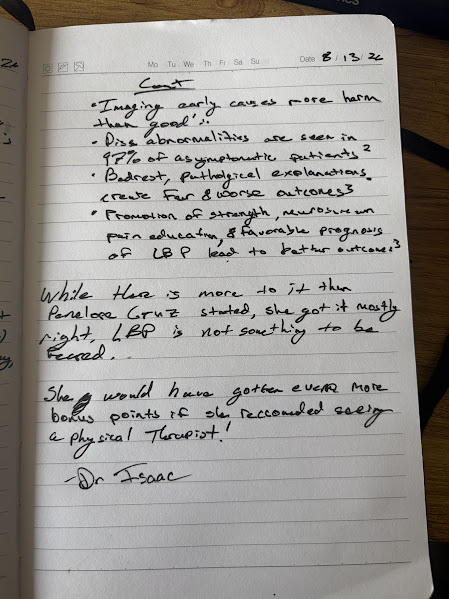
"Something showed up on my MRI" doesn't mean "something is broken." Disc abnormalities show up in roughly 97% of people who have zero back pain symptoms at all. If we scanned everyone walking around pain free, most of them would "fail" the imaging test too.
Early imaging often does more harm than good. Jumping straight to an MRI for a new episode of back pain frequently leads people down a path of unnecessary worry, unnecessary procedures, and worse outcomes, not because the scan is wrong, but because normal, age related findings get mistaken for the source of the pain.
Fear is often a bigger problem than the pain itself. Bedrest and scary sounding explanations ("your spine is degenerating," "you have a bulging disc") tend to create more fear and worse outcomes over time than the pain would on its own.
What actually helps: building strength, understanding how pain works (it's not always a direct signal of tissue damage), and hearing a realistic, favorable prognosis. All three are linked to better outcomes.
The takeaway
Low back pain is common, it's rarely dangerous, and it's very rarely something imaging alone can explain. Stress, mood, sleep, and how threatening you perceive the pain to be all genuinely influence how much pain you feel, which is exactly what that movie scene captured, whether the writers meant to or not.
It's not "all in your head." It's that your nervous system is more sensitive to threat when you're already stretched thin, and less sensitive when you're not.
If there's a lesson in a Seth Rogen comedy about back pain, it's this: don't panic, don't stay in bed, and don't let a scary word on a radiology report convince you that you're fragile. See a physical therapist, get moving, and get the full picture.
Dr. Isaac
Resources
AI Disclaimer: AI was used in cleaning up this post, however, all orginal thoughts. See pictures below.



Comments